Monday, February 26, 2024

GONE VIRAL


The Cathedral House of Good has been sidelined due to COVID 19 and may be coming back now.  I’m happy to say all Bishops, staff, every in-person attendee and all on-line members have weathered the storm, and have practiced the CDC guidelines for pandemics and were vaccinated to good avail.  


Since Nature and the mystery of existence are central to the Cathedral, I have struggled how to respond given the catastrophic, tragic effects throughout the world.  Can I see anything  spiritual in the pandemic?  Or anything uplifting?  I can’t really say the Virus is evil.  It just is. But it’s effects have definitely been tragic from our perspectives.  


Over the last few years—starting before the pandemic—I have been receiving randomly and 5 times daily, reminders through an app that I’m going to die.  Bhutan Buddhist, I’m told, do this so as to engender a greater appreciation of life.  And I can confirm it’s so.  The reminders have helped me be more conscious of the value of life and even stirred more gratitude for everyday happenings that could easily and unmindfully pass.  


Of necessity I have been outdoors more with increased direct and open sharing of existence with animals, plants and fungi. I’ve seen afresh awe inspiring photosynthesis.  With a new puppy, I’ve shared the mystery of relating to another emotional, joyful, and willful being and celebrating the joy of experiencing newness and amazement at every turn, as well as a host of physiological processes underscoring life.  I’ve been grateful for the recovery of friends and family struck with COVID; shared the angst of other friends and family; and even felt a closer bond with everyone (isolated as we were at times) by being thankful for each of their contributions to daily living—from the doctors who treated us, to the person who sold me food, the postman, the grounds keepers where I walked.  Basically I mean everyone.  I could see how everyone contributes.  


So the worse of the pandemic appears to have passed, even if it still threatens at times.  But even before it’s fading I have been able to venture out and about.  I have visited several cathedrals and churches as a part of ecumenical efforts and will share some of this later.  I hope to make more postings but only as I feel prompted by some mysterious force.    


And may Mysterious Forces be with us all!  And keep us safe and secure.


                                                       — the Bishop 

Thursday, April 30, 2020

A GOOD BOOK

On the surface Lessons of the Lotus is not a complicated book.  It deals in a straightforward manner with several important topics.  The profundity is grasping these ideas and applying them.

The lotus grows from a muddy layer below water and the flower blossoms beautifully at the surface.  So there already is a lesson:  Wonders can come from unexpected even hidden places.  This is no less true for us than objects.

The author is a Sri Lankan Buddhist Monk,  Bhante Y. Wimala who in his early 20's decided to become a traveling Monk instead of pursuing a more in depth study in a monastery.  He is the man who first taught me meditation about 25 years ago and apparently wrote this book shortly after I had met him.  When I first saw him at the retreat center, I was impressed with his demeanor:  he projected peace and calm with a groundedness.  And these features are reflected in his book.

He forgoes a more scholarly, detailed look at Buddhist teachings and philosophy in order to stress a more practical approach to overcoming suffering and finding happiness.

He speaks of our inner essence as a part of us that transcends our conscious self.  And we can access it by recognizing our connection to nature and others.  Introspection, honesty, curiosity help in the journey.   The practice of loving-kindness to all living beings goes a long way to end suffering.   Of course it is difficult to love people who are harsh or even evil.  He gives advice on approaching such people without ignoring their negative aspects or being victim to them.  And he shares the story of the Buddha converting a mass murderer through loving kindness into a conscientious loving Monk.

Meditation is a key element.  He describes it easily and points to it's usefulness in calming the mind and helping us get beyond the everyday chatter of existence and see life more transcendent.  Living in the present moment is important.

He also looks at Karma.  Karma is not getting what we deserve but more the consequence of our actions be they positive or negative.  And this can and does happen in the current moment even if a Buddhist view is also it can play out over several lifetimes.

What a pleasure to discover Bhante Wilmala's book.  While I haven't seen him since he taught me meditation, I have maintained a respect and gratitude for him.  And now I have more thanks for his straightforward and profound guide to living and transcending suffering.

                                                                       ---the Bishop

About Bhante Y. Wimala | Samadhi Buddhist Meditation Center
Bhante Wilmala


Tuesday, April 28, 2020

Ex Cathedra

Really from December 2019:  We have been silent lately--I'm not sure who this collective We is, perhaps God and me or more likely just the many important aspects of the Bishopric.  Nevertheless it has been a while since I, no we, have commented.  And this is probably a result of the vow of silence We often take in the Cathedral House of Good.  It's a version of "If you can't say anything good, don't say anything."  But of course there is also a bit of laziness, time crunch and no inspiration.  The latter is important since We have indeed a strong Quaker influence.  We are also influenced by the Procrastination Society.

We have traveled since the last blog and so some sacred spaces even in Singapore and Vietnam not to mention the States.  Perhaps soon I will be moved by Christmas, Hanukkah and Kwanzaa, along with these other sacred spaces. 

                                                              --the Bishop

Tuesday, March 24, 2020

MY BEEF WITH GRIEF

Slightly more than 50 years ago as a  young medical student I sat in on my first case conference with a skilled attending psychiatrist interviewing a depressed widow.  She was sadden to the point of not eating or sleeping and was contemplating suicide.  And what was the precipitant of this extreme state?  The death of her cherished dog!  I recall in my early 20's thinking how silly to be so attached to a dog.  Oh, I had so much to experience.

The psychoanalytic interpretation that day was that the dog was a displacement from the loss of her husband.  This made sense to me.   I had had only a few losses by that time even if they had been very significant: my father and grandfathers and even a few dogs, with the latter getting little regard.

Now fast forward 50 plus years. My looses have multiplied of course including family, friends, and acquaintances.  I have been able to acknowledge and experience grief repeatedly.

Recently my life partner and I had to euthanize her increasingly debilitated poodle.  She had known the dog 11 years and I had known her 8 years.  Sadness has overwhelmed us both.  Sadness for the loss of Isadora herself!  And in this grief I recall my case conference of 50 years ago.

Isadora was a wonderful, gentle dog, affectionate and ever present.  She was non-intrusive but engaging and ever conscious and accommodating of her master's mood.  We grieve for other losses and our own mortality but we also grieve for Isadora.  She is gone and we will miss her sorely.

                                                                              -- the Bishop


Friday, February 7, 2020

A GOOD BOOK IF ONLY BECAUSE IT'S INTERESTING

James, the Brother of Jesus:  the Key to Understanding the Secrets of Early Christianity and the Dead Sea Scrolls by Robert Eiseman.

What a scrupulously researched and detailed book!  The author weaves together an exhaustive list of ancient documents which include canonical and non canonical works (Jewish and Christian), the Dead Sea Scrolls, ancient historians and many more.  It took me months to complete and I think it would really require a PhD for me to fully evaluate it.  Eiseman uses philology, etymology, historical criticism, and deep knowledge of comparative religions and ancient history.  He connects dots in such a remarkable way that I'm not sure he is not creating dots.

But the basic theory as I understand it (and it would have to remain a theory for me) associates the earliest Jesus followers (earliest Christians) in the general apocalyptic milieu of the era.  So the earliest followers would have been more militant, staunchly observant of the Torah, messianic, rebellious, and ritualistic.  It would not have been a turn the other cheek religion.

James is portrayed as the brother of Jesus and his successor as leader of the group on Jesus' crucifixion.  And Eiseman contends James was effectively written out of the cannon by the followers of Paul in a effort to basically allow the Pauline version of Christianity of prosper--a version more in cooperation with the Romans and more identified with love and a heavenly kingdom instead of an Earthly one.  Paul's early persecution of the new sect gave way to his being the major proponent.  Eiseman contends Paul actually was responsible for an attack on James which was rewritten in the New Testament as the stoning of Stephen and even to some extent in suicide description of Judas.

An intriguing aspect of the book for me is that it gives a plausible, even if inaccurate, picture of how early Christianity could have developed in a time of intense religious and political upheaval.  When we read the current cannon, we are perhaps only reading the final victorious version of conflicting and battling ideas, beliefs and practices.

                                                                          --the Bishop


Monday, August 19, 2019

WHAT TO BELIEVE?

 Reading through a religious insert in my local newspaper I came across many intriguing articles.  It was a little unclear what group was sponsoring these viewpoints, but at least some of the authors were  from a local group affiliated with a movement that has split from a national church over doctrinal issues.  One such article delved into history of our identities and ultimately focused on the sacrifice of Dietrich Bonhoeffer.  Quoted was his poem that vouchsafed him as belonging to God, in face of Nazism even while fearing execution.  Of course being the cynic I am, I also saw support for the breakaway group to maintain courage and recognition that they truly belonged to God unlike the National Church.  Of course this is unspoken since the locals are not really in Bonhoeffer's circumstances and the National Church is not Nazism, no matter how much they're seen unorthodox.

Another fascinating article admonished against fighting poverty by taking from some and giving to others.  To underscore this absurdity an example was to take all of Bill Gates wealth and distribute it to everyone with each getting only $300.  And this would be just a one time event.  Of course this idea of taking from some (the wealthy) and giving to others (poor, non-workers, derelicts) is often a code phrase for lamenting taxes, even a progressive system, and is an easy strawman.    Taxes contribute to general benefits and I'm sure each of us can find some objections to the spending of some tax dollars.  Nevertheless, the Common Good is a far cry from taking from some to give to others even if there are some efforts to provide a safety net--or health care, disability benefits, education, prevent  hunger.   

But the most catching article for me was the one dealing with "Focusing on Basics" with supertitle of "Prodigal Son"--recall there are two diocesan congregations apart at the moment and who might be symbolically the Prodigal Son I couldn't say except for perhaps both.  Aren't we all?

The author laments how minor details can obscure the really important messages of the church.  Gay marriage, abortion, women priests, adult versus childhood baptism, type of music--and I'll add more: the day to the week of worship, handling snakes, speaking in tongues, dancing, alcohol, caffeine, and countless more.  I concur with the author that such matters are not very important as denominational determinants.  He does believe however that "cultural" wars are important.  It's just you don't want to overwhelm a new convert too quickly.

My biggest disappointment came after the author had trumpeted the value of transcending minor beliefs for a more profound and inclusive experience.  This inclusive experience turns out to be what we must say as we stand before "God in judgement."  For him this is where the rubber hits the road.  It's a test.  And the correct answer "better include" a version of accepting the doctrine of atonement salvation.  I must point out that not even all Christians accept this doctrine and this does not even address the billions who profess Judaism, Islam, Buddhism, forms of what we call Hinduism, and countless other beliefs I can't list for space.

It reminds me of the statement attributed to Jesus about not worrying about the mote in your neighbors eye when there is a beam in your own.   I would write more, but my eyes  hurt.

                                                                --the Bishop

Monday, April 15, 2019

THE NICELY LEAN CREED

IN-CREED-IBLE

Recently I was attending a friend's church--in my usual ecumenical mood--and found I was unable to recite the Nicene Creed because it basically contained so much I did not believe.  The Creed is a centerpiece of this (and many other) churches.  It originated in 4th century when the Emperor Constantine was trying to unify his empire and church authorities had similar ideas of unifying the faith.  It was not universally accepted in its day and was part of much blood shed and suffering before it came into final acceptance.  Many Protestant churches don't use the creed today, not because they don't believe most of its content but because it was Papist.  Today of course I don't have to worry about being tortured by the Catholics although  at times I do worry about the Protestants.  So I decided it was time for us to have our own creed, which of course we would never use since we don't believe in creeds. 


The Nicely Lean Creed:

I believe in God-- mysterious, unfathomable, multifaceted, knowable, ever present yet probably non-existent. 

I believe in Jesus a guide to and spokesman for God.  He was born and remained Jewish and before his death, he was never a Christian.

I believe a Divine Spirit is present in many places and people and in fact permeates all of life.


For debate on the above Creed, a convocation of Bishops was convened at the Cathedral House of Good with a quorum present.  After prolonged debate, the Creed was accepted without opposition.  Conditions for approval were that it would never be part of a service and would not be an article of faith. 

Below is the Nicene Creed (or a version of it) that I was unable to justify reading while on an ecumenical visit. 

                                                the Bishop


Nicene Creed:  

I believe in one God,
the Father almighty,
maker of heaven and earth,
of all things visible and invisible.

I believe in one Lord Jesus Christ,
the Only Begotten Son of God,
born of the Father before all ages.
God from God, Light from Light,
true God from true God,
begotten, not made, consubstantial with the Father;
through him all things were made.
For us men and for our salvation
he came down from heaven,
and by the Holy Spirit was incarnate of the Virgin Mary,
and became man.
For our sake he was crucified under Pontius Pilate,
he suffered death and was buried,
and rose again on the third day
in accordance with the Scriptures.
He ascended into heaven
and is seated at the right hand of the Father.
He will come again in glory
to judge the living and the dead
and his kingdom will have no end.

I believe in the Holy Spirit, the Lord, the giver of life,
who proceeds from the Father and the Son,
who with the Father and the Son is adored and glorified,
who has spoken through the prophets.

I believe in one, holy, catholic and apostolic Church.
I confess one Baptism for the forgiveness of sins
and I look forward to the resurrection of the dead
and the life of the world to come. Amen.

SABBATICAL

I've been traveling in an ecumencal mood of course for several months.  In Mexico I was part of a Mayan blessing and also celebrated Christmas among hundreds of jovial religionists. In Florida I witness Yahweh's triumph over Baal.   In Lisbon I made a pilgrimage to an open arms Jesus.  And in Rome I gave homage to countless churches, basilicas and cathedrals.  I visited catacombs and payed respect at the tomb of St. Peter below his basilica.  And in addition I venerated Mithras at an altar in excavations two layers down from a 12th century basilica.  And in Pompeii I revered the Temple of Jupiter.  And finally in Frankfurt, I respected the church where emperors were crowned for hundreds of years.  There was simply no shortage of ecumenical moments.  The bizarrest to me in Rome was the body of Pope John XXIII laid out in a glass coffin.  They didn't seem to be expecting a resuscitation but they did expected him to act saintly. 
Frankfurt               
         Pompeii                
 Mithras
St. Peter's Tomb

Moses in Church of St Peter in Chains
Cristo Rei
Mexican Snow
Florida
Pair of  Shamans


-----the Bishop


Monday, October 8, 2018

THANK GOODNESS!

Recently I evacuated my area when a hurricane threatened.  It was a category 4 which eventually downgraded to category 2 before landfall and missed my area almost completely but devastated areas further up the coast.  At my evacuation site before I knew its course, I was channel surfing for news when I came across the CBN--Christian Broadcasting Network-- and heard Pat Robertson say thanks to all the CBN prayers, the hurricane  had already lessened to category 2.  At that point the hurricane came ashore, wobbled, slowed, and dumped rain for hours, caused massive flooding and ultimately killed scores of people.  I was so thankful for their prayers.  If not for CBN it could have easily been another Puerto Rico!  (I wonder if Robertson prayed for PR.)

Often I read posts attributing avoidance of natural catastrophes and miracles to divine mercy.  Once I met a woman ecstatic because God had given her a car.   People can see a divine purpose in finding a mall parking space.  People see miraculous cures of illness and pray for such recoveries in special services.  I think I have a better chance of finding a parking space than I have of moving a storm.  Call me a cynic I guess.  But it's enough to drive me to atheism, thank God (as a friend's father used to say before he was called to Glory).

Of course all religions claim divine intervention with prayer and miraculous cures.  And I know others who send out "light" and "goodness" as interventions in life's struggles.  And I recall a friend, an atheist, who was diagnosed with a terminal cancer.  He then arranged all his affairs and papers with his very pessimistic viewpoint.  But when he went to another medical center for specialized treatment he discovered his cancer had left, remitted.  Of course this was without prayer or hope on his part.  Just another expression of life as he saw it.  But of course I can't say others were not praying for him.  After all people do win the lottery.  And one has a slightly better chance of winning if you buy a ticket (only very slightly)--after all someone may buy a ticket for you.

Certainly the unexpected and even the unimagined happens in life.  Thank goodness!  In fact all of life is unexpected and unimaginable.  And maintaining a sense of wonder and gratitude seems warranted.  Let's take a deep  breath and enjoy it.  And furthermore, when someone else suffers let's join them in empathy and loving kindness knowing we all suffer.  It's not that God shines his mercy on us and not you.  We're all one.


Monday, August 6, 2018

THE GOOD BOOK

The Light of Fireflies by Paul Pen is a very difficult, troubling, tragic story, odd from beginning to end.  Early on a major character says there is nothing more amazing than a creature that produces its own light.  And this maybe the compelling truth of the this story, this situation, and this family--but on some level it will shine true for us all--and thus makes it into my religious opinions.  For this set of protagonists there seems to be no other source of light.  There is darkness everywhere, seeping through everything.  Lies stack on lies, love mask crimes and guilt, blame excuses torture, damaged naivete obscures beastly brutality, togetherness blocks freedom,  conviviality hides lack of respect for personal boundaries, steadfastness hides slavery, gentleness overshadow meanness.  Have I said it is a dark difficult story--hard to read (but also hard to not read)?  It reflects to some extent in all of us, that is all of us who care to look into the basements of our souls.  And if we don't care to look into our souls then we just don't see what's there anyway.

Into a this strange underworld is born one of our nameless protagonists.  He is born in a basement with the understanding that there are no exits and no leaving.  It's all mysterious but mystery only begins when we have questions and it takes some growing to have questions.  His parents have disfiguring burn scars and his sister is so disfigured she must wear a mask so he will never be frightened by her appearance.  And grandmother is blind from the fire.  A brother is just mentally stunted and is in frequent idiosyncratic reverie.  However this youth is a clever boy who enjoys a book on insects, his cactus and following a ray of sunshine seeping in from a crack in the ceiling as it crosses the floor. He cradles an unfertilized egg hoping to have baby chick.  His blind grandmother encourages hopes by claiming to show the chick climbing about her only to say later it must have escaped the window (which is barred).  He eventually collects a group of fireflies whose light becomes his inspiration, hope, strength, courage, and source of freedom.

The opening scenes show his father as a doting loving father only to have him appear as a criticizing harsh brute 10 years later.  The developing youth wonders about origin of life, the behaviors he observes, and  in addition to many other things, the nature of mammal offspring (a real reference to humans).  Things go from bad to worse for the youth and the family.  Some family members play one against the other.  Confusion abounds.  Truth is elusive.  Naive childhood protection against suspected wrongs transforms into an unexpected battle with evil.  And through it all the family is together-- held by guilt, codependency, and fear.

The bottle of fireflies--those amazing creatures that produce their own light and that had drifted in from the outside--instill the  young hero with strength to go forward.  In one particular sanguine episode the bottle is broken and the fireflies escape.   The  youth sees them swirling around but no one else sees them!  Now it's clear where the light originated.   Our 10 year old gallant knight is the amazing creature that produces his own light.

This nameless youth grows up in the outside world glowing in the light of the world and spreading his inner light to his child and nephew (the latter also born in the basement).  But it is not necessarily a  happy ending for the rest of the family.  To escape your self imposed bondage and free yourself from rationalizations are difficult and with time efforts become fossilized, stifled, immobile.  And one just continues to do what one has known even if wishing otherwise.

Paul Pen merritts title of author of a good  book that shows us the light--even if it is dark and difficult.

Related image


Wednesday, July 11, 2018

Matthew 5:25

Breaking Up Is So Hard To Do

As a complete outsider I have been watching a local Schism take place. Well, maybe not as a complete outsider--I do live in the community and have many friends in the churches.  A local mainstream Bishop took as much of his congregation as were willing out of the national church , claiming that his groups was maintaining the true traditional faith and the national group was just a blasphemous watered down version of sin.  The breaking point issue, at least as seems obvious from outsiders, is homosexuality and how to deal with the gay population (and of course the entire LGBT community).  The split away group sees the Bible as clear  in labeling homosexuality a sin while the national church takes a more inclusive non-judgemental stance.  This has played out in many denominations across the country.  The split-aways stress they still love gays but must point out their errant ways.

Compounding the debate about sin and love is the fact that property and money are involved.  The spit-away group hoped to take the properties with them but has been faced with court rulings that return the property to the national church.  This includes some very historical and wealthy churches that date to the earliest times of the state.

And of course the locals wish to point out that it's really a matter of loyalty to Biblical inerrancy and tradition that motivates the schism.  The national church they say has abandoned true religion for a liberal satanic version.  The nationals do this by being inclusive, opened minded to point of recognizing the value of other religions.  In short they take a more ecumenical approach.

There have been many public letters back and forth from both sides.  Each calls for reconciliation but more or less on their own terms.  The locals battle on despite the court's rulings against them.  They often stress the 3-2 vote of the state supreme court as if somehow that means it doesn't really count. And they indicated they will continue to find some issue to dispute in court even if it doesn't really involve the major properties any longer.  For example who can use the seal and logo.  I doubt eviction is a real concern.  At most I could see the national church installing new clergy for what part of the congregation wanted to stay in the prodigal churches.

What does not seem to be a possibility at the moment is simply going your own way.  It's often not just enough to believe you are right but you must also show the other wrong.   It's like lots of marriages I've seen end.  Or even business partnerships.  It's hard to let go and live and let live.

It's nice to know nothing like this could happen the Cathedral House of Good. First of all there is hardly any tradition to follow and everyone in welcome.   Furthermore there is no property. There are not even enough people to have a schism.   Maybe when global warming floods out all the other churches, Good's Cathedral will see a schismatic influx.  

Saturday, May 19, 2018

The Good Book

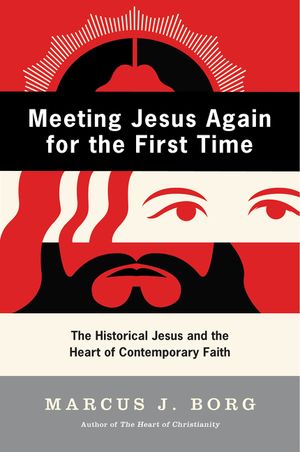
Meeting Jesus Again for the First Time:  the Historical Jesus and the Heart of Contemporary Faith by Marcus Borg is the Good Book for now.  
Borg like many of us first met Jesus in his family's church (Lutheran for him) but has evolved his awareness and relationship through out his life.  And his 30 years plus as a scholar of early Christianity and the Bible have helped.  
Borg sketches Jesus in a manner very different than we learned in Church or that we routinely hear even now among mainstream discussions.  No longer to be found are images of Jesus as divine or as savior by atonement for everyone's sins.  There are no indications he spoke of himself as the son of God, or planned to start a new religion.  He is not the judge of right and wrong and does not insist on believing. 
Instead the Jesus we meet is a "Spirit Man," one of those people who relates to Spirit (and in his Jewish culture this is Yahweh) and can communicate this relationship to others.  And he invites others to relate to this Spirit too.  He stresses a resistance to the prevailing cultural worldly powers as a means of transformation and liberation.  An interesting irony is that even the current church culture can become an oppressive power.  Compassion is the overriding current in Jesus' ministry.  
There was nothing on Easter morning that could have been video taped.  For Borg, the idea of an empty tomb is irrelevant.  What was being described were experiences of the early followers who continued to feel Jesus' presence and influence in there lives.  They could say, "he is Risen and he is Lord."  
And much of what we read in the Canon is the post-resurrection community's efforts to metaphorically express their feelings and experiences of Jesus.  So they saw him as  someone they could hear and see.  Some thought he must have had a special birth.  Perhaps he was even present from the beginning.  
Cover image - Meeting Jesus Again for the First Time   
Borg easily merits the title of author of a Good Book.
                                                                           ------ the Bishop
                

Wednesday, May 2, 2018

A New God?

         
Bhagwan Shree Rajneesh-- I had forgotten him.  But then I recalled those turbulent, controversial days in Oregon in the early 1980's.  He came out of India to settle in central Oregon with quick confrontation with the authorities.  His followers were moving there, buying property and voting.  And then there were his counter culture teachings of sexual liberation and love.  I remember him as the Cadillac Guru who drove around his compound in his  sedan with followers throwing flowers on his hood.  His Ashram came to an ignominious end in the mid 1980's when his private secretary and a small cadre were implicated in heinous crimes including plots to murder local and federal officials and poisoning a local restaurant salad bar. There has been no substantial evidence that Rajneesh himself was involved in the crimes but he did plead guilty to an immigration offense and was deported.  He eventually returned to India where he has become more popular than  before and has even undergone what some have called an apotheosis. 

In autumn 2002 I went to a retreat in the NC mountains with a group of Osho followers.  I didn't know Osho but learned he was a new incarnation of a guru who had died in the 1990's.  Previously he had been Bhagwan Shree Rajneesh! What I went too I would call a dance meditation--not being into the language of the group.  A free style movement, present in the now was what I experienced.  They were a pleasant group with many having Eastern names in place of their Western birth names.  They emphasized love and basically emanated peace.  All this along with hikes in the mountains added up to a very nice weekend for me.  I've had no further contact with the group.

All this came back to me today when I read an article from a researcher at the University of Oregon who conducted research on the group in the 1980's in Oregon and later into the late 1990's with members who had moved on to different locations.  

The researcher pointed out that members continued to hold faith in Rajneesh (Osho) into the late 1990's and saw him as a great force in transforming their lives and helping them live comfortably with their goals and balance the many difficult conflicts of life and career.  Two thirds of the Oregon followers had college degrees and/or lucrative careers.  More than half were women.  And many of these had left successful well paying careers because they still felt lonely and anxious and thrived in the love and affirmation of Rajneesh.  

As mentioned, Osho has been undergoing something of an apotheosis.  So perhaps we are seeing formed now, a major religion of tomorrow just as Christianity formed in the first and second centuries.  I imagine most contemporaries never even heard of Jesus and his followers and most who did found the whole idea as absurd.  Jesus in his day was  a Roman criminal and had his own counter culture movement.  And even so the movement changed with time and came to dominate the Western world.  

Also today I read the basic "Ten Commandments" of Osho.  They really don't seem such a bad set of principles to live by:  

  1.  Never obey anyone's command unless it is coming from within you also.
  2. There is no God other than life itself.
  3. Truth is within you, do not search for it elsewhere.
  4. Love is prayer.
  5. To become a nothingness is the door to truth. Nothingness itself is the means, the goal and attainment.
  6. Life is now and here.
  7. Live wakefully.
  8. Do not swim—float.
  9. Die each moment so that you can be new each moment.
  10. Do not search. That which is, is. Stop and see.

                                                                                 ---- the Bishop

Image result for Bhagwan Shree Rajneesh


Tuesday, April 24, 2018

It's a Resurrection not a Resuscitation

A casual comment  reminded today of an experience several years ago in the Thyssen- Bornemisza Museum in Madrid.  After closely admiring a painting (now forgotten) I turned left 90 degrees and came suddenly and unexpectedly face to face with life size image of "the Resuscitated Christ."  His expression of sadness and suffering was palpable.  I was looking into his watery eyes, gaunt cheeks, and his slightly opened mouth.   He had an air of bewilderment and seemed to question what had happened and why.  A very human Jesus was looking for consolation while at the same time giving hope.  For me at that moment Jesus was very much alive!

The reverie passed and I moved on to other art in the museum, in that day before good cell phone cameras.  But in fact it never occurred to me to photograph the painting since my experience was not photographable.  To be in the presence of the Divine is unforgettable.

But forgettable were the name of the artist and time of completion.  All I could recall was some school from the 15th century and I wasn't' sure of that.

Subsequent Google searches have not produced totally conclusive results, but almost.  And looking online at wonderful art is not the same as being there, especially true when the experience is numinous. 

At the Thyssen, there is a painting from the late 1400's once attributed to Bramate but more likely by his student Bramantino.  But it's title is "the Risen Christ," not "the Resuscitated Christ" that I recalled.  Is it the same painting?  Has my memory just tricked me?  Has the title been changed?  Did I see what I already believed?  Actually it was probably my thinking in English and reading in Spanish.  You know, Cristo Resuscitado.  But whatever was the case, from the 500 year old painting, I was able to see a living Jesus.  He stood removed from canvass and not confined by frame.  His shining tears, the warmth of his breath, and the smell of his wounds hung in the air.  There was not a single word, just acknowledgement.

I assume Bramantino and Bramante must have had a similar experience and brought it to life on canvass.  And I can understand too how then this experience has proceeded for milenia from the earliest such experiences.

Which brings me what I heard today:  a local Roman Catholic clergy reported Easter that "it was a resurrection and not a resuscitation."  As this was a second hand report to me, I have no idea what the clergyman meant but you can see how it brought me back to the Thyssen Resuscitated versus the Risen Christ.

From what I can tell, the general belief is that resuscitation refers to a person coming to life again in the same body only to die again later.  Resurrection is to rise from the dead with a different even glorified body never to die again.  These are probably more important distinctions to believers in the traditional Christian doctrines.  But for me both words can be used and are used to designate  "revivalize."  You can resurrect an old idea or resuscitate a forgotten technique.  And you can revitalize the ability to experience the mysteries of life.

A Jesus 500 years encased in canvass burst to life for me.  And Elijah can walk through opened doors.  Ganesha can remove obstacles.  Buddha can bring peace.

To be clear, I am not referring to a physical resurrection.  The Jesus I encountered was no physical body but a mental--or spiritual if you will--experience.  But that is no less real.  My scientific orientation tells me physical bodies die and don't return.  But images and experiences can be without time constraints, caught in the eternal moment.  And as such, the numinous of life, the sacredness of being, can be reinvigorated, revitalized and rejuvenated.  It's not resuscitation.  It's resurrection!

                                                                            ---the Bishop


Cristo Resucitado
https://www.google.com/search?q=cristo+resucitado+thyssen+museum&tbm=isch&source=iu&ictx=1&fir=ctxAHdVJE4v1AM%253A%252CWUrkECPS4cp-QM%252C_&usg=__nkkyyTpUf3cm2ddbwl4Ni6Ul0jc%3D&sa=X&ved=0ahUKEwiT9-r2h9baAhWK1lMKHeW0CVYQ9QEINDAB#imgrc=ctxAHdVJE4v1AM:

Monday, April 23, 2018

A little something about the Bishop

His Happiness, the Good Revved Dr. P. R. Gunter


My background of involvement as a minister in a denominational movement began in 1969 with my ordination in the Universal Life Church under leadership of Kirby Hensley. Like Hensley, I learned later, I had grown disappointed with my religious life and affiliation and sought some relief; and comic relief was good enough for me.   As I remember there was somewhere in ULC's official wordings the statement "It's all funny until you believe." I was also affiliated with some other fine groups.  The Unitarians have a solid if not funny church with no burdensome doctrines.  The Buddhists may be the most reasonable of all.   The Hindus were  broad, open and flexible.

There were also some not so reasonable groups for me. The Presbyterian--founded by John Calvin who had no humor and would burn you at the stake in a skinny minute.  Lutheran--founded by Martin Luther a real tight ass, quite literally.  Episcopalian--where do I begin--with Henry VIII?  Baptist--boy could they have used a drink.  Methodist--I didn't see a much different method than the Baptists. Quakers--a quiet bunch.  Roman Catholics--really celibacy and weird birth control?  And they started and perpetuated much of this mess we have.  Orthodox Catholics--they sound so nice but surely they burned somebody and also there are no super-titles in the services.  Latter Day Saints--whatever they are they are gold plated. Pentecostal---I couldn't understand what they were saying.  Unity--touchy-feely, but not so grounded at times.   Christian Science--I kept looking for the science part.  Non-Denominational--follow the money. Scientology--maybe it was founded by an Alien.

In those days nearly 50 years ago my ministry was limited to blessing the beer at parties, occasional memorial services for anatomy cadavers, and prayer services to aid my fellow students pass their tests.  The parties were successful and all students graduated and no cadavers complained.

Kirby was an illiterate, self taught eccentric who left every minister alone to pursue their own path and had no rigid, onerous doctrinal  requirement.  I had grown up in churches and felt relaxed in them, I noticed, until dogma arrived.  And dogma invariably arrived brought by serious minded, educated, well meaning people--clergy and lay.  Hensley's approach was refreshing and thumb in the eye of those who used degrees to bash everyone with doctrines or beliefs as well as to those not so well educated who just took what they had always  heard with no questioning.

Hensley contended all was legal and all ministers were fully qualified for their ministerial duties.  I certainly had no one question my roll in those days.  However I never had any brick and mortar church and never got into tax issues or funds.  In the early 1970's I became an apostate and eventually lost track of the ULC.  About that time too I learned the ULC was having IRS problems with charges of tax evasion.  This was my time to explore all those other groups.

But I continued holding forth as  a ULC minister.  At times I would bring out my ordination card and humorously tell my story through the years.   It was usually a a time when someone needed a little religious humor.  A good laugh goes a long way.

Fast forward to the late 1990's.  A friend who had been one of those in need of the humor when he was being defrocked from his church due to his liberal beliefs asked me to perform his wedding. This took my ministry to a new level.  I had to officially register in his county as a "minister of the Gospel."  And of course I had a  Gospel to share!

Weddings beget weddings so another ensued.  But weddings are not my real interest. I'm  more interested in what people believe, the meaning of beliefs and why we believe what we believe. This I hope will be the focus of this blog.   We shall see!

With my friends' wedding I returned to the ULC and after a rigorous exam became a Doctor of Metaphysics so I could understand anything and everything.  More importantly I patted myself on the back (a form of laying on of hands) and became a Bishop, a recognition of my 30 years plus as ordained minister with the ULC.  By the way, I was not ordained by this current fad of on-line ordinations.  I did it by the old fad of snail mail--envelop and stamp.  Ordination papers then were really sealed certificates, not these printed out versions--which are just as legal.

And the ministry continues with support for the orthodox challenged,  the eccentric or free thinker, and those in need of a laugh.

The following link provides an interesting sweeping history of the Universal Life Church--although I can't vouch for it's accuracy.  Some see Hensley as a complete fraud or con artist and others see him a religious seeker.  I'm thinking about making him a  saint.  Saint Kirby!  But I'm having a little trouble. I don't know any miracle he performed.   I haven't heard of anyone healed by him. But there is the story that he liked to say the ULC was the only church ever declared a legal church by the U.S. Court System and so acknowledged by the IRS.  Maybe that's enough.


http://califias.blogspot.com/2014/11/the-universal-life-church.html

Wednesday, April 4, 2018

Easter 2018

For Easter reading I recommend E. Bruce Brooks' book:  Jesus and After  The First Eighty Years.

The author analyzes the New Testament Canon as a philologist and shows a chronology of canonical writings from the earliest to the latest with interpolations.  He distinguishes alpha Christians (the earliest), beta Christians (the second wave) and even gamma Christians (Gnostic).  The alphas did not focus on resurrection and stressed doing good deeds and keeping the law, with Jesus as their guide to return to God.  Much of Mark is in this vein as is also Epistle of James (to Brooks this is Jacob as a more authentic name).  Paul began his mission before the end of the  Apostolic Age and in fact saw himself as an Apostle by Jesus Christ and is pretty much the inventor of the beta beliefs.  He stressed the resurrection and atonement for forgiveness of sins. 

Brooks shows how the early Christians usurped the Jewish texts for their purposes and how later the beta group usurped alpha writings by insertions for their purposes.  The three epistles of John show this transition well.  

The alpha group was basically a sect of Judaism and even kept some of the writings along side the Torah in synagogues.  With the destruction of the Temple in 70 A.D. Judaism and the Christian groups became less centralize (not in Jerusalem any more).  Christianity became an almost exclusive gentile religion.  Initially Matthew as Brooks sees it became the most vocal to distinguish the Christian sect from Judaism, not so much as anti-Semitic as pushing for direct ownership of their religion.  There are conflicts back and forth among the alpha and beta groups too.  Each group considered itself the correct interpreter and sent letters to churches admonishing adherence to their views and rejection of the other.  

Brooks' chronology is a little different than what I have seen with other scholars but not so far off. Mark he dates to the 40's and John's Gospel to around the 80's.  Matthew and Luke are in between. But interpolated parts and revisions of all the Canon are at different dates.  

Eventually too Brooks deals with the writings of the Church Fathers e.g. Clement.   I havn't yet finished the book but I will by Easter and will update this blog.  

                                                                                              ----The Bishop

Thursday, March 29, 2018

Jesus and After continued


The latter part of Brooks' book deals with the gamma Christians i.e. the Gnostic group.  They offered another way to salvation.  Theirs was through a special knowledge, not from good works (alpha) nor from sacrificial atonement (beta).  This was especially strong in early second century and again in the 3rd century in some who objected to the Trinity Doctrine had been recently codified.  They could not logically grasp how a Father and Son could both exist eternally simultaneously (the construct in the Nicene Creed).  The Son from the Father also implied a more human Jesus--also an alpha Christian concept.  These anti-trinity believers were banished outside the Roman Empire but persisted and reemerged in the Reformation and even exist today (e.g. modern Unitarian-Universalist Church). 

While Brooks says his book is not a history book but rather a philology work, he paints a vivid historical sweep of Jesus' ministry, his death, and subsequent events.  We see the changes in writing that take Jesus from being human calling for a return to God (Mark) to Jesus being recognize before his ministry with special birth (Matthew and Luke) to his being the same as God (John).  The more simple Christian sect is seen in early Mark, the Epistle of James, and the Didache.  Paul in his writings brings in the atonement understanding and Jesus dying for salvation and his resurrection as assurance for His followers.  The Canon contains evidence of struggles between the two groups to sway people from the other group even to the point of usurping the other's text by interpolations.

                                                                                       
                                                                                          ----the Bishop


GONE VIRAL The Cathedral House of Good has been sidelined due to COVID 19 and may be coming back now.   I’m happy to say all Bishops, staff,...