Monday, April 15, 2019

THE NICELY LEAN CREED

IN-CREED-IBLE

Recently I was attending a friend's church--in my usual ecumenical mood--and found I was unable to recite the Nicene Creed because it basically contained so much I did not believe.  The Creed is a centerpiece of this (and many other) churches.  It originated in 4th century when the Emperor Constantine was trying to unify his empire and church authorities had similar ideas of unifying the faith.  It was not universally accepted in its day and was part of much blood shed and suffering before it came into final acceptance.  Many Protestant churches don't use the creed today, not because they don't believe most of its content but because it was Papist.  Today of course I don't have to worry about being tortured by the Catholics although  at times I do worry about the Protestants.  So I decided it was time for us to have our own creed, which of course we would never use since we don't believe in creeds. 


The Nicely Lean Creed:

I believe in God-- mysterious, unfathomable, multifaceted, knowable, ever present yet probably non-existent. 

I believe in Jesus a guide to and spokesman for God.  He was born and remained Jewish and before his death, he was never a Christian.

I believe a Divine Spirit is present in many places and people and in fact permeates all of life.


For debate on the above Creed, a convocation of Bishops was convened at the Cathedral House of Good with a quorum present.  After prolonged debate, the Creed was accepted without opposition.  Conditions for approval were that it would never be part of a service and would not be an article of faith. 

Below is the Nicene Creed (or a version of it) that I was unable to justify reading while on an ecumenical visit. 

                                                the Bishop


Nicene Creed:  

I believe in one God,
the Father almighty,
maker of heaven and earth,
of all things visible and invisible.

I believe in one Lord Jesus Christ,
the Only Begotten Son of God,
born of the Father before all ages.
God from God, Light from Light,
true God from true God,
begotten, not made, consubstantial with the Father;
through him all things were made.
For us men and for our salvation
he came down from heaven,
and by the Holy Spirit was incarnate of the Virgin Mary,
and became man.
For our sake he was crucified under Pontius Pilate,
he suffered death and was buried,
and rose again on the third day
in accordance with the Scriptures.
He ascended into heaven
and is seated at the right hand of the Father.
He will come again in glory
to judge the living and the dead
and his kingdom will have no end.

I believe in the Holy Spirit, the Lord, the giver of life,
who proceeds from the Father and the Son,
who with the Father and the Son is adored and glorified,
who has spoken through the prophets.

I believe in one, holy, catholic and apostolic Church.
I confess one Baptism for the forgiveness of sins
and I look forward to the resurrection of the dead
and the life of the world to come. Amen.

SABBATICAL

I've been traveling in an ecumencal mood of course for several months.  In Mexico I was part of a Mayan blessing and also celebrated Christmas among hundreds of jovial religionists. In Florida I witness Yahweh's triumph over Baal.   In Lisbon I made a pilgrimage to an open arms Jesus.  And in Rome I gave homage to countless churches, basilicas and cathedrals.  I visited catacombs and payed respect at the tomb of St. Peter below his basilica.  And in addition I venerated Mithras at an altar in excavations two layers down from a 12th century basilica.  And in Pompeii I revered the Temple of Jupiter.  And finally in Frankfurt, I respected the church where emperors were crowned for hundreds of years.  There was simply no shortage of ecumenical moments.  The bizarrest to me in Rome was the body of Pope John XXIII laid out in a glass coffin.  They didn't seem to be expecting a resuscitation but they did expected him to act saintly. 
Frankfurt               
         Pompeii                
 Mithras
St. Peter's Tomb

Moses in Church of St Peter in Chains
Cristo Rei
Mexican Snow
Florida
Pair of  Shamans


-----the Bishop


Monday, October 8, 2018

THANK GOODNESS!

Recently I evacuated my area when a hurricane threatened.  It was a category 4 which eventually downgraded to category 2 before landfall and missed my area almost completely but devastated areas further up the coast.  At my evacuation site before I knew its course, I was channel surfing for news when I came across the CBN--Christian Broadcasting Network-- and heard Pat Robertson say thanks to all the CBN prayers, the hurricane  had already lessened to category 2.  At that point the hurricane came ashore, wobbled, slowed, and dumped rain for hours, caused massive flooding and ultimately killed scores of people.  I was so thankful for their prayers.  If not for CBN it could have easily been another Puerto Rico!  (I wonder if Robertson prayed for PR.)

Often I read posts attributing avoidance of natural catastrophes and miracles to divine mercy.  Once I met a woman ecstatic because God had given her a car.   People can see a divine purpose in finding a mall parking space.  People see miraculous cures of illness and pray for such recoveries in special services.  I think I have a better chance of finding a parking space than I have of moving a storm.  Call me a cynic I guess.  But it's enough to drive me to atheism, thank God (as a friend's father used to say before he was called to Glory).

Of course all religions claim divine intervention with prayer and miraculous cures.  And I know others who send out "light" and "goodness" as interventions in life's struggles.  And I recall a friend, an atheist, who was diagnosed with a terminal cancer.  He then arranged all his affairs and papers with his very pessimistic viewpoint.  But when he went to another medical center for specialized treatment he discovered his cancer had left, remitted.  Of course this was without prayer or hope on his part.  Just another expression of life as he saw it.  But of course I can't say others were not praying for him.  After all people do win the lottery.  And one has a slightly better chance of winning if you buy a ticket (only very slightly)--after all someone may buy a ticket for you.

Certainly the unexpected and even the unimagined happens in life.  Thank goodness!  In fact all of life is unexpected and unimaginable.  And maintaining a sense of wonder and gratitude seems warranted.  Let's take a deep  breath and enjoy it.  And furthermore, when someone else suffers let's join them in empathy and loving kindness knowing we all suffer.  It's not that God shines his mercy on us and not you.  We're all one.


Monday, August 6, 2018

THE GOOD BOOK

The Light of Fireflies by Paul Pen is a very difficult, troubling, tragic story, odd from beginning to end.  Early on a major character says there is nothing more amazing than a creature that produces its own light.  And this maybe the compelling truth of the this story, this situation, and this family--but on some level it will shine true for us all--and thus makes it into my religious opinions.  For this set of protagonists there seems to be no other source of light.  There is darkness everywhere, seeping through everything.  Lies stack on lies, love mask crimes and guilt, blame excuses torture, damaged naivete obscures beastly brutality, togetherness blocks freedom,  conviviality hides lack of respect for personal boundaries, steadfastness hides slavery, gentleness overshadow meanness.  Have I said it is a dark difficult story--hard to read (but also hard to not read)?  It reflects to some extent in all of us, that is all of us who care to look into the basements of our souls.  And if we don't care to look into our souls then we just don't see what's there anyway.

Into a this strange underworld is born one of our nameless protagonists.  He is born in a basement with the understanding that there are no exits and no leaving.  It's all mysterious but mystery only begins when we have questions and it takes some growing to have questions.  His parents have disfiguring burn scars and his sister is so disfigured she must wear a mask so he will never be frightened by her appearance.  And grandmother is blind from the fire.  A brother is just mentally stunted and is in frequent idiosyncratic reverie.  However this youth is a clever boy who enjoys a book on insects, his cactus and following a ray of sunshine seeping in from a crack in the ceiling as it crosses the floor. He cradles an unfertilized egg hoping to have baby chick.  His blind grandmother encourages hopes by claiming to show the chick climbing about her only to say later it must have escaped the window (which is barred).  He eventually collects a group of fireflies whose light becomes his inspiration, hope, strength, courage, and source of freedom.

The opening scenes show his father as a doting loving father only to have him appear as a criticizing harsh brute 10 years later.  The developing youth wonders about origin of life, the behaviors he observes, and  in addition to many other things, the nature of mammal offspring (a real reference to humans).  Things go from bad to worse for the youth and the family.  Some family members play one against the other.  Confusion abounds.  Truth is elusive.  Naive childhood protection against suspected wrongs transforms into an unexpected battle with evil.  And through it all the family is together-- held by guilt, codependency, and fear.

The bottle of fireflies--those amazing creatures that produce their own light and that had drifted in from the outside--instill the  young hero with strength to go forward.  In one particular sanguine episode the bottle is broken and the fireflies escape.   The  youth sees them swirling around but no one else sees them!  Now it's clear where the light originated.   Our 10 year old gallant knight is the amazing creature that produces his own light.

This nameless youth grows up in the outside world glowing in the light of the world and spreading his inner light to his child and nephew (the latter also born in the basement).  But it is not necessarily a  happy ending for the rest of the family.  To escape your self imposed bondage and free yourself from rationalizations are difficult and with time efforts become fossilized, stifled, immobile.  And one just continues to do what one has known even if wishing otherwise.

Paul Pen merritts title of author of a good  book that shows us the light--even if it is dark and difficult.

Related image


Wednesday, July 11, 2018

Matthew 5:25

Breaking Up Is So Hard To Do

As a complete outsider I have been watching a local Schism take place. Well, maybe not as a complete outsider--I do live in the community and have many friends in the churches.  A local mainstream Bishop took as much of his congregation as were willing out of the national church , claiming that his groups was maintaining the true traditional faith and the national group was just a blasphemous watered down version of sin.  The breaking point issue, at least as seems obvious from outsiders, is homosexuality and how to deal with the gay population (and of course the entire LGBT community).  The split away group sees the Bible as clear  in labeling homosexuality a sin while the national church takes a more inclusive non-judgemental stance.  This has played out in many denominations across the country.  The split-aways stress they still love gays but must point out their errant ways.

Compounding the debate about sin and love is the fact that property and money are involved.  The spit-away group hoped to take the properties with them but has been faced with court rulings that return the property to the national church.  This includes some very historical and wealthy churches that date to the earliest times of the state.

And of course the locals wish to point out that it's really a matter of loyalty to Biblical inerrancy and tradition that motivates the schism.  The national church they say has abandoned true religion for a liberal satanic version.  The nationals do this by being inclusive, opened minded to point of recognizing the value of other religions.  In short they take a more ecumenical approach.

There have been many public letters back and forth from both sides.  Each calls for reconciliation but more or less on their own terms.  The locals battle on despite the court's rulings against them.  They often stress the 3-2 vote of the state supreme court as if somehow that means it doesn't really count. And they indicated they will continue to find some issue to dispute in court even if it doesn't really involve the major properties any longer.  For example who can use the seal and logo.  I doubt eviction is a real concern.  At most I could see the national church installing new clergy for what part of the congregation wanted to stay in the prodigal churches.

What does not seem to be a possibility at the moment is simply going your own way.  It's often not just enough to believe you are right but you must also show the other wrong.   It's like lots of marriages I've seen end.  Or even business partnerships.  It's hard to let go and live and let live.

It's nice to know nothing like this could happen the Cathedral House of Good. First of all there is hardly any tradition to follow and everyone in welcome.   Furthermore there is no property. There are not even enough people to have a schism.   Maybe when global warming floods out all the other churches, Good's Cathedral will see a schismatic influx.  

Saturday, May 19, 2018

The Good Book

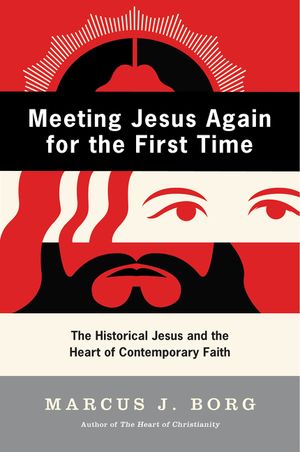
Meeting Jesus Again for the First Time:  the Historical Jesus and the Heart of Contemporary Faith by Marcus Borg is the Good Book for now.  
Borg like many of us first met Jesus in his family's church (Lutheran for him) but has evolved his awareness and relationship through out his life.  And his 30 years plus as a scholar of early Christianity and the Bible have helped.  
Borg sketches Jesus in a manner very different than we learned in Church or that we routinely hear even now among mainstream discussions.  No longer to be found are images of Jesus as divine or as savior by atonement for everyone's sins.  There are no indications he spoke of himself as the son of God, or planned to start a new religion.  He is not the judge of right and wrong and does not insist on believing. 
Instead the Jesus we meet is a "Spirit Man," one of those people who relates to Spirit (and in his Jewish culture this is Yahweh) and can communicate this relationship to others.  And he invites others to relate to this Spirit too.  He stresses a resistance to the prevailing cultural worldly powers as a means of transformation and liberation.  An interesting irony is that even the current church culture can become an oppressive power.  Compassion is the overriding current in Jesus' ministry.  
There was nothing on Easter morning that could have been video taped.  For Borg, the idea of an empty tomb is irrelevant.  What was being described were experiences of the early followers who continued to feel Jesus' presence and influence in there lives.  They could say, "he is Risen and he is Lord."  
And much of what we read in the Canon is the post-resurrection community's efforts to metaphorically express their feelings and experiences of Jesus.  So they saw him as  someone they could hear and see.  Some thought he must have had a special birth.  Perhaps he was even present from the beginning.  
Cover image - Meeting Jesus Again for the First Time   
Borg easily merits the title of author of a Good Book.
                                                                           ------ the Bishop
                

Wednesday, May 2, 2018

A New God?

         
Bhagwan Shree Rajneesh-- I had forgotten him.  But then I recalled those turbulent, controversial days in Oregon in the early 1980's.  He came out of India to settle in central Oregon with quick confrontation with the authorities.  His followers were moving there, buying property and voting.  And then there were his counter culture teachings of sexual liberation and love.  I remember him as the Cadillac Guru who drove around his compound in his  sedan with followers throwing flowers on his hood.  His Ashram came to an ignominious end in the mid 1980's when his private secretary and a small cadre were implicated in heinous crimes including plots to murder local and federal officials and poisoning a local restaurant salad bar. There has been no substantial evidence that Rajneesh himself was involved in the crimes but he did plead guilty to an immigration offense and was deported.  He eventually returned to India where he has become more popular than  before and has even undergone what some have called an apotheosis. 

In autumn 2002 I went to a retreat in the NC mountains with a group of Osho followers.  I didn't know Osho but learned he was a new incarnation of a guru who had died in the 1990's.  Previously he had been Bhagwan Shree Rajneesh! What I went too I would call a dance meditation--not being into the language of the group.  A free style movement, present in the now was what I experienced.  They were a pleasant group with many having Eastern names in place of their Western birth names.  They emphasized love and basically emanated peace.  All this along with hikes in the mountains added up to a very nice weekend for me.  I've had no further contact with the group.

All this came back to me today when I read an article from a researcher at the University of Oregon who conducted research on the group in the 1980's in Oregon and later into the late 1990's with members who had moved on to different locations.  

The researcher pointed out that members continued to hold faith in Rajneesh (Osho) into the late 1990's and saw him as a great force in transforming their lives and helping them live comfortably with their goals and balance the many difficult conflicts of life and career.  Two thirds of the Oregon followers had college degrees and/or lucrative careers.  More than half were women.  And many of these had left successful well paying careers because they still felt lonely and anxious and thrived in the love and affirmation of Rajneesh.  

As mentioned, Osho has been undergoing something of an apotheosis.  So perhaps we are seeing formed now, a major religion of tomorrow just as Christianity formed in the first and second centuries.  I imagine most contemporaries never even heard of Jesus and his followers and most who did found the whole idea as absurd.  Jesus in his day was  a Roman criminal and had his own counter culture movement.  And even so the movement changed with time and came to dominate the Western world.  

Also today I read the basic "Ten Commandments" of Osho.  They really don't seem such a bad set of principles to live by:  

  1.  Never obey anyone's command unless it is coming from within you also.
  2. There is no God other than life itself.
  3. Truth is within you, do not search for it elsewhere.
  4. Love is prayer.
  5. To become a nothingness is the door to truth. Nothingness itself is the means, the goal and attainment.
  6. Life is now and here.
  7. Live wakefully.
  8. Do not swim—float.
  9. Die each moment so that you can be new each moment.
  10. Do not search. That which is, is. Stop and see.

                                                                                 ---- the Bishop

Image result for Bhagwan Shree Rajneesh


GONE VIRAL The Cathedral House of Good has been sidelined due to COVID 19 and may be coming back now.   I’m happy to say all Bishops, staff,...